
Dyscalculia: Signs, Challenges and Support at Different Ages
Many people find maths challenging, but lasting difficulty with numbers can point to more than a need for extra practice. A child may recite numbers without knowing what they mean. A teenager may follow a percentage example in class, then freeze on a similar exam question. An adult may quietly avoid bills and timetables. One possible explanation is dyscalculia. This guide explains what it can look like at each age, how it affects daily life, and what support may help.
Quick answer: Dyscalculia is a specific learning difficulty that affects how a person understands and works with numbers. It can involve quantities, maths facts, calculation, time, money and measurement. Signs vary by person and age, so a professional assessment is the reliable way to understand persistent difficulties.
What Is Dyscalculia?
Dyscalculia is a learning difficulty that can make maths and number-related tasks more challenging. A person may have difficulty understanding quantities, recognising number relationships, doing calculations, remembering mathematical steps, or applying maths in everyday situations. These challenges can continue even when the person has received appropriate teaching and practice. Dyscalculia is not a reflection of intelligence, motivation, or effort, it simply means that certain aspects of mathematical learning may require different approaches and additional support.
The pattern differs from person to person. One learner grasps ideas but slips on calculation. Another calculates well but cannot apply it at a shop counter. Dyscalculia can also occur alongside dyslexia or ADHD. Some learners additionally have working-memory difficulties, which can make it harder to hold numbers in mind during multi-step calculations.
What Are the Signs of Dyscalculia?
The signs of dyscalculia are a persistent pattern of difficulty with number concepts, calculation and everyday numerical tasks. No single sign confirms it. Families and teachers often mention:
- Confusing which of two amounts is bigger
- Struggling to link a numeral with the quantity it stands for
- Forgetting maths facts that seemed learned last week
- Frequent calculation errors
- Losing the thread in multi-step problems
- Unusual difficulty with time, money or measurement
- Trouble reading graphs and charts
These signs can overlap with missed lessons, attention difficulties or maths anxiety. Treat a checklist as a reason to look closer, not as a verdict.
What Does Dyscalculia Look Like in Children?
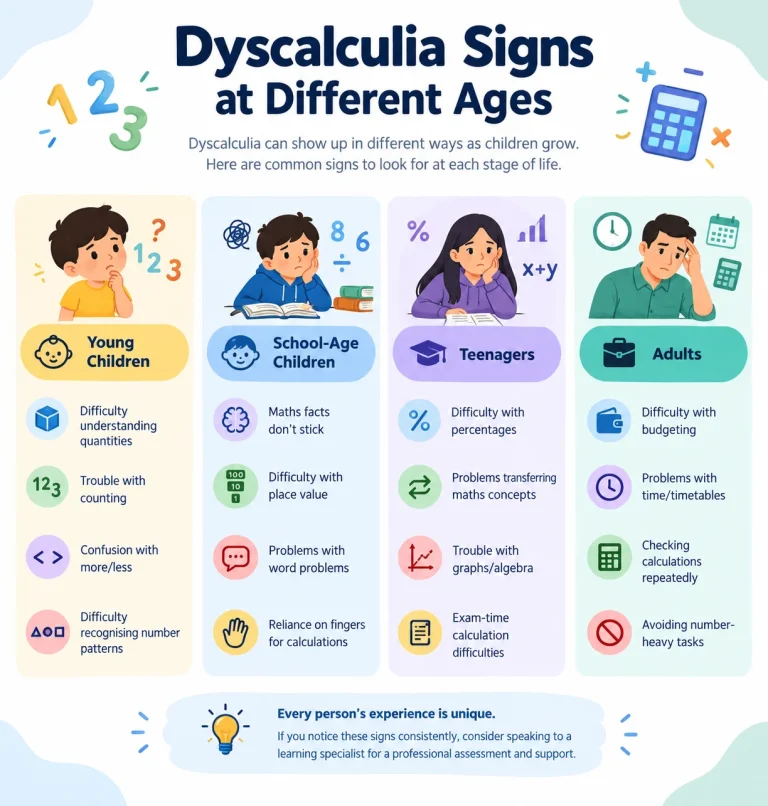
In children, dyscalculia often starts with the meaning of numbers rather than exam marks. What you notice depends on the stage.
Young children. A child may count aloud smoothly but not know that “five” means five objects. Words like “more” and “less” can feel slippery, and sorting by size may be tough. Children develop at different speeds, so watch for a pattern over time rather than one slow week.
School-age children. Once formal maths begins, gaps become easier to see. A child may still count on fingers for small sums or lose track of place value. Times tables refuse to stick. In word problems, the child may understand the story but not know which operation to use. Where written work and examinations carry weight, these difficulties can become especially noticeable.
Repeated difficulty can also lead to frustration, avoidance or anxiety. These reactions do not diagnose dyscalculia, but they can signal that a learner needs more support.
How Does Dyscalculia Affect Teenagers?
Dyscalculia in teenagers often becomes more visible because maths turns abstract. Routines that carried a child through primary school stop working when algebra, ratios and multi-step problems arrive.
A teenager may follow a worked example, then struggle to transfer the idea to a new question. Graphs and geometry may confuse. Physics and chemistry calculations can pull marks down even when the concepts are clear. Managing time in exams may suffer too.
Some teenagers cover up by joking, skipping class or claiming they don’t care. Often this hides fear of being judged. Asking “Which part feels hardest?” usually works better than “Try harder.”
What Are the Signs of Dyscalculia in Adults?
Dyscalculia can affect adults as well, and some were never assessed in childhood. Adult dyscalculia often shows through workarounds rather than test scores.
In daily life, this may mean:
- Relying on a calculator for simple sums
- Finding it hard to compare prices, check change or manage a budget
- Misjudging how long a task or journey will take
- Struggling with timetables, shift schedules or clock reading
- Forgetting PINs, codes or phone numbers
- Avoiding jobs or courses that involve figures
At work, someone might recheck every invoice or feel tense during stock counts. Many adults develop their own strategies to compensate, but these workarounds can take extra time and effort. These difficulties are not a reflection of a person’s intelligence or overall ability. Our guide to learning difficulties in adults covers the wider picture.
Is It Dyscalculia, General Maths Difficulty or Something Else?
Many people struggle with maths at some point, and that alone does not point to dyscalculia. The comparison below shows the kind of differences that may prompt a closer look.
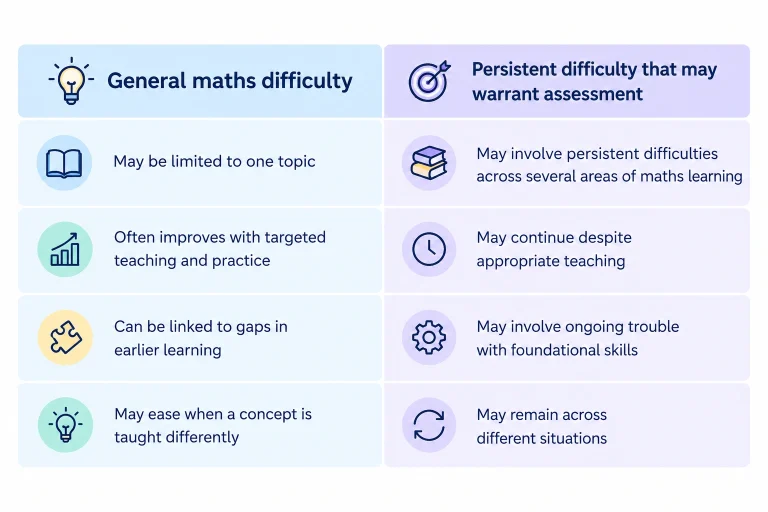
This is not a diagnostic test. A professional assessment can help distinguish persistent maths difficulties from those caused by other factors, such as attention, unclear instruction or maths anxiety.
How is dyscalculia different from dyslexia?
Dyscalculia mainly affects mathematical and numerical learning, while dyslexia mainly affects reading and language-related processing. Some learners have both, or also have ADHD. That is why assessment should consider the whole learning profile, not just one subject. For a deeper understanding, explore our detailed guide on dyslexia.
How Is Dyscalculia Assessed, and What Support Can Help?
A dyscalculia assessment looks at how someone handles numbers and where they get stuck. It may review number understanding, calculation, reasoning, memory, processing speed and learning history. For adults, it also considers how the difficulty affects study or work. One test rarely tells the whole story.
Dyscalculia is generally understood as a persistent learning difficulty. The underlying difficulty may continue, but suitable support can help people build skills and strategies. Results vary, and the approach should fit the person. Learners often benefit from:
- One-to-one support that strengthens foundational number skills
- Concrete tools such as counters and number lines before abstract methods
- Small, sequenced steps with regular review
- Diagrams and real-life examples, such as money and measuring
- Calculators or extra time where appropriate
- Encouragement that eases maths anxiety
More worksheets rarely solve the problem. Tuition may focus on practising subject content, while remedial support takes a more individualised approach: it identifies specific skill gaps and adapts teaching around them.
When should you consider professional support?
Consider an assessment if difficulties persist despite appropriate teaching and practice, or if they affect school, independence or work. Examples include a child still struggling with basic number ideas, a teenager finding routine maths unusually hard, or an adult regularly avoiding money and time tasks. The aim is understanding, not labelling.
Finding Dyscalculia Support in Kerala
Families in Kerala often begin by noting what the learner finds hard and for how long, then speaking with a qualified special educator or psychologist. An individualised learning assessment can clarify strengths, specific difficulties and appropriate next steps, which is more reliable than relying on online checklists alone.
Conclusion
Dyscalculia can show up as a five-year-old counting beans, a teenager facing algebra, or an adult managing household money. The signs change with age, but the message holds: persistent difficulty with numbers is not necessarily a reflection of effort or overall ability. It may relate to how a learner processes and understands mathematical information.
If these struggles continue despite consistent support, a professional assessment can help identify what is really going on. At First Learn, our RCI-licensed special educators provide learning disability support and one-to-one remedial training shaped around each learner’s needs. Understanding the difficulty can be an important first step toward building confidence and more effective strategies with numbers.
Frequently Asked Questions
1. What are the signs of dyscalculia?
Common signs include difficulty judging quantities, remembering maths facts, calculating, estimating, and handling time or money. They vary by age and person. Because other factors can cause similar difficulties, a professional assessment helps clarify what lies behind them.
2. Can adults have dyscalculia?
Yes. Dyscalculia can affect adults, and some were never assessed as children. It often appears as difficulty with budgeting, time, measurements or workplace figures, or as avoiding number-heavy tasks. Practical strategies and support can help adults feel more confident.
3. Does dyscalculia mean low intelligence?
No. Dyscalculia is unrelated to overall intelligence. Many people with it have strong verbal, creative or problem-solving abilities. The difficulty is specific to how numbers and quantities are processed.
4. What is the difference between dyscalculia and dyslexia?
Dyscalculia mainly affects number and maths learning, while dyslexia mainly affects reading and language processing. Some people experience both. An assessment that looks at the full learning profile can show which areas need support.
5. Will extra tuition help a child with dyscalculia?
Tuition often focuses on practising subject content, which may not address the underlying skill gaps. Remedial support looks at where number understanding breaks down and adapts teaching in smaller, concrete steps. An assessment can help families decide which fits better.
Contact Us
Book a Consultation with Mahin Unais
Whether you’re a concerned parent or educator, we’re here to guide you. Schedule a session to discuss your child’s learning needs and explore how we can help them thrive.
Get in Touch
3rd Floor, Square Nine Mall, New Bus Stand, Big Bazar, Kasaragod, Kerala 671121
+91 95264 10045
firstlearnclinic@gmail.com
Send Us a Message
First Learn is a leading special education clinic in Kasaragod, offering special education, remedial therapy and learning disability support through personalised one-to-one sessions for children, teens and adults.
© 2026 First Learn Learning Clinic. All rights reserved.