ADHD and Learning Difficulties: A Guide for Parents
A child may be bright, curious and capable, yet still struggle to finish homework, follow instructions, remember what they have learned or keep up with classroom work. For parents exploring ADHD and learning difficulties in Kerala, these patterns can raise questions about what may be affecting their child’s learning.
ADHD and learning difficulties can overlap, but they are not the same thing. ADHD primarily involves ongoing difficulties related to attention and/or hyperactivity-impulsivity, while specific learning difficulties affect particular academic skills such as reading, writing or mathematics. Some children may experience both.
Understanding the difference can help parents look beyond marks or behaviour and consider what type of support may be appropriate.
What Is ADHD?
Attention-deficit/hyperactivity disorder (ADHD) is a neurodevelopmental condition that can affect attention, impulse control and activity levels. It can look different from one child to another.
Some children mainly experience inattentive symptoms, while others have more hyperactive-impulsive symptoms or a combination of both. A child with predominantly inattentive symptoms may appear quiet but frequently forget instructions, lose materials, overlook details or struggle to organise and complete tasks.
This is important because ADHD does not always look like constant physical activity.
A child who spends a long time staring at a worksheet, forgets what they were asked to do or repeatedly needs reminders may also be experiencing attention-related difficulties.
ADHD vs Learning Difficulties: What's the Difference?
ADHD and learning difficulties can affect school performance in different ways.
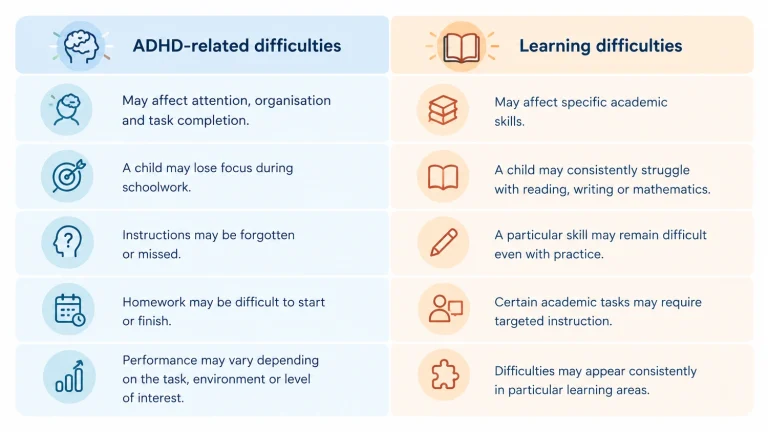
These patterns can overlap. For example, a child may avoid reading because maintaining attention is difficult—or because reading itself is genuinely challenging.
Understanding ADHD and learning difficulties in Kerala in this broader context can help parents look beyond a child’s marks and consider what type of support may be appropriate.
Can ADHD and Learning Difficulties Occur Together?
Yes. A child can have ADHD as well as a specific learning difficulty.
For example, a child may have difficulty sustaining attention while also experiencing persistent problems with reading accuracy, spelling or mathematical skills. When both are present, schoolwork can become particularly frustrating because the child may have difficulty both staying engaged with a task and performing the underlying skill.
This can sometimes create a confusing pattern for parents:
“They understand it one day, but struggle with it the next.”
Inconsistent performance does not automatically mean a child is unwilling to learn. Task demands, attention, organisation, memory and underlying academic skills may all influence how a child performs at a particular time.
How ADHD Can Affect Learning
For some children, ADHD can make everyday school routines and academic tasks harder to manage.
ADHD and Executive Functioning
Executive functioning includes skills involved in organising, starting, managing and completing tasks.
A child may struggle with:
- Starting homework without repeated prompting
- Breaking a large assignment into smaller steps
- Remembering instructions
- Managing school materials
- Moving from one activity to another
- Estimating how long a task will take
- Completing work independently
- Checking work before handing it in
These difficulties can make ordinary school routines feel much harder than they appear from the outside. Organisational and time-management support can be particularly relevant for students experiencing these challenges.
When ADHD Doesn't Look Hyperactive
Not every child with ADHD is visibly restless or disruptive.
Some children may instead appear distracted, forgetful, slow to begin work or frequently lost in their thoughts. They may miss parts of classroom explanations or need instructions repeated several times.
Because these children may not draw attention through disruptive behaviour, their learning difficulties can sometimes be overlooked.
ADHD, Reading, Writing and Mathematics
Attention difficulties can interfere with academic learning, but they do not automatically mean that a child has a learning disability.
A child may:
- Have difficulty recalling the main idea after finishing a passage
- Skip words because they lose their place
- Make careless errors while writing
- Forget what they were supposed to include in an answer
- Leave mathematical problems unfinished
- Miss steps in calculations
- Struggle with lengthy written assignments
However, persistent difficulty with a specific academic skill may require closer attention.
For example, if a child consistently struggles with decoding words, spelling, written expression or number concepts even when attention is supported, it may be useful to explore whether there is an underlying learning difficulty as well.
Common ADHD and Homework Difficulties
Homework can make attention and organisation problems especially visible.
Parents may notice that their child:
- Takes an unusually long time to begin
- Needs frequent reminders to stay with the task
- Leaves work incomplete
- Becomes distracted by small things
- Forgets what the assignment requires
- Becomes overwhelmed by several instructions
- Loses books, worksheets or stationery
- Makes avoidable mistakes
- Needs an adult nearby throughout the entire task
These patterns do not necessarily mean the child is lazy or unwilling to learn.
Sometimes the difficulty lies in starting, organising, sustaining or completing the task rather than understanding the lesson itself.
Why the Difference Matters
Identifying the nature of a child’s difficulty matters because different problems may require different forms of support.
If attention and organisation are major barriers, strategies may focus on routines, task breakdown, clear instructions and planning.
If a child has persistent difficulties with reading, writing or mathematics, more targeted academic intervention may be appropriate.
When both types of difficulties are present, support may need to address both the child’s learning skills and the factors affecting their ability to engage with schoolwork.
ADHD diagnosis itself is a clinical process. There is no single test that establishes ADHD, and other conditions can sometimes produce similar difficulties. Parents who are concerned about possible ADHD should discuss those concerns with an appropriately qualified healthcare professional.
How Parents and Schools Can Support Learning
Support works best when adults look at the child’s actual difficulties rather than focusing only on marks or behaviour.
Parents and schools can consider practical strategies such as:
- Giving instructions in clear, manageable steps
- Checking that the child understands what needs to be done
- Breaking lengthy assignments into smaller tasks
- Using predictable routines
- Providing reminders for important materials
- Allowing appropriate movement or short breaks
- Helping the child organise schoolwork
- Giving feedback on progress
- Communicating regularly about difficulties and improvements
School-based support can include organisational strategies and other educational adjustments depending on the child’s needs. Collaboration between families, schools and relevant professionals can help create more consistent support.
When Should Parents Consider Assessment or Professional Support?
For families concerned about ADHD and learning difficulties in Kerala, further guidance may be worth considering when difficulties are persistent, affecting everyday learning, and not improving despite reasonable teaching, practice and support.
Parents may want to explore assessment when a child repeatedly:
- Struggles with reading, writing or mathematics
- Cannot follow multi-step instructions
- Needs constant prompting to complete ordinary school tasks
- Has difficulty remembering recently taught information
- Takes significantly longer than expected to complete work
- Avoids particular academic activities
- Shows a large gap between what they appear to understand and what they can demonstrate
- Experiences difficulties across home and school routines
A learning assessment can help identify areas of strength and difficulty. It does not mean that a child is being labelled as incapable. Instead, it can provide useful information about what is making learning difficult and what type of support may be appropriate.
When Might a Child Benefit From Learning Support?
Not every child who struggles with attention or schoolwork needs specialised learning support.
However, additional support may be worth considering when difficulties continue to interfere with reading, writing, mathematics, following instructions, organising schoolwork or completing tasks independently.
Depending on the learner’s needs, support may include special education support, remedial training, individualised learning strategies or one-to-one learning support.
The goal is not simply to improve marks. It is to understand the learner’s difficulties and provide appropriate support for developing academic skills, independence and confidence.
ADHD Learning Support in Kerala: Understanding the Next Step
For families exploring ADHD and learning difficulties in Kerala, it is important to separate medical ADHD care from educational support.
ADHD diagnosis and medical management should be handled by appropriately qualified healthcare professionals. At the same time, a child’s academic difficulties can be explored separately to understand whether additional learning support is needed.
In Kerala, inclusive education frameworks also recognise the importance of identifying learning needs and providing appropriate educational support for children with special educational needs.
At First Learn, a special education and learning support clinic in Kasaragod, support focuses on understanding individual learning needs and providing appropriate educational intervention.
The type of support can vary according to the learner’s individual requirements, such as:
- Learning assessment
- Special education support
- Remedial training
- One-to-one learning support
- Reading, writing and mathematics support
- Individualised learning strategies
- Support with attention and task organisation
- Progress monitoring and parent guidance
You can explore First Learn’s Special Education, Learning Disability Support, and Remedial Therapy services to understand the different types of support available.
Frequently Asked Questions
1. Can ADHD cause learning difficulties?
ADHD can interfere with attention, organisation, task completion and following instructions, which can make learning more difficult. However, ADHD is not the same as a specific learning difficulty. Some children may experience both.
2. Is ADHD always associated with hyperactivity?
No. ADHD can present predominantly through inattentive symptoms, including forgetfulness, difficulty organising tasks, losing focus and trouble following or completing instructions.
3. How can parents tell whether a problem is ADHD or a learning difficulty?
It is not always possible to tell from everyday behaviour alone. A child who avoids reading, for example, may be experiencing attention difficulties, an underlying reading difficulty, or both. An appropriate evaluation can help clarify the pattern of difficulties.
4. Where can parents seek learning support for a child with ADHD-related difficulties?
Parents can begin by discussing concerns with the child’s school and, when appropriate, a qualified healthcare professional. If academic difficulties continue, a learning assessment may help identify areas requiring additional educational support. First Learn Kasaragod provides learning assessment, special education support, remedial training and one-to-one learning support for children, teenagers and adults.
Contact Us
Book a Consultation with Mahin Unais
Whether you’re a concerned parent or educator, we’re here to guide you. Schedule a session to discuss your child’s learning needs and explore how we can help them thrive.
Get in Touch
3rd Floor, Square Nine Mall, New Bus Stand, Big Bazar, Kasaragod, Kerala 671121
+91 95264 10045
firstlearnclinic@gmail.com
Send Us a Message
First Learn is a leading special education clinic in Kasaragod, offering special education, remedial therapy and learning disability support through personalised one-to-one sessions for children, teens and adults.
© 2026 First Learn Learning Clinic. All rights reserved.